
Genoa’s Hidden Charms and a Fond Farewell
Chapter Seven of Across Europe's Heart: A Ligurian Adventure
Keith Pryke
2/8/20265 min read
The Mediterranean sun filtered through my apartment window, gently rousing me for my last full day in the city. With the journey home looming tomorrow, I aimed to uncover areas of the city I hadn't yet seen, while still taking time to revisit a few favourites, letting Genoa's rhythm guide me one last time. The weather was perfect, with a bright sky, a few drifting clouds and temperatures hovering in the low 20s—an ideal day for wandering.
I started with a stroll along Corso Andrea Podestà, a wide avenue that crosses the imposing Ponte Monumentale bridge, a few steps from my apartment. Just a short distance south of my starting point, I marvelled at the beautiful steps that led to Via Innocenzo Frugoni. It was a cascading stone staircase, with weathered steps, flanked by tall buildings painted in soft pastel tones, where towering Mediterranean pines stood guard. But it was the ornate wrought-iron railings, twisted into elegant, swirling patterns that caught my eye the most, the morning sun shining through, casting intricate shadows on the ancient pavement.
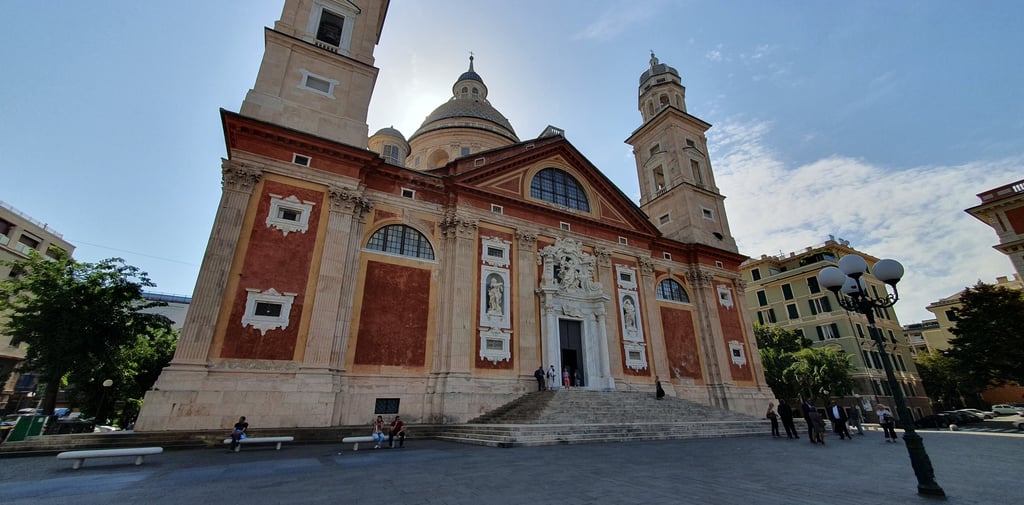
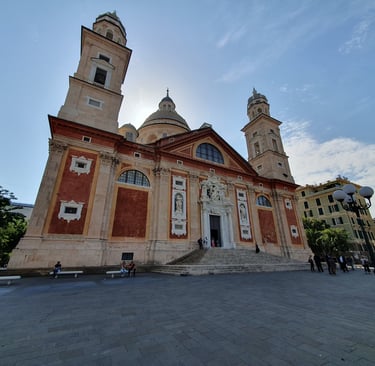
I continued ahead into the Carignano district, first onto Via Corsica, then right up Via Nino Bixio. These streets, broader, more elegant, and well-kept, were a stark contrast to the caruggi across the city. Less touristy, these residential areas for the wealthier Genoese exuded quiet sophistication. This route led to Santa Maria Assunta, a majestic Baroque church, its grand facade a striking blend of elegance and solidity. Bathed in warm sunlight, it featured two towering bell towers flanking a central dome, their creamy stonework accented with reddish-brown hues, giving it a rich, earthy glow. The facade was adorned with ornate columns and arched windows, each framed with delicate carvings, while statues nestled into niches added a touch of reverence. Designed by Galeazzo Alessi and built on a hill between 1552 and 1615 to dominate the cityscape, it features a central dome and symmetrical layout that reflect influences from St. Peter’s Basilica in Rome, standing as a symbol of Genoa’s maritime prosperity during its Golden Age, when the city thrived as a maritime republic. Its role now was that of a spiritual and social hub for this upscale district.
Descending the hill, I made my way to the Casa di Cristoforo Colombo, a site steeped in the legacy of the famed explorer. Born in 1451 in Genoa, Christopher Columbus grew up in a modest weaver’s family near this spot; his early life here, amid the bustling port, sparked his fascination with the sea, leading to his groundbreaking voyages under the Spanish flag. In 1492, he reached the Americas, opening a new chapter in global exploration. The house, a reconstructed 13th-century dwelling, is believed to stand near his childhood home, though its exact authenticity is debated. Preserved since the 18th century, it now offers a glimpse into his humble beginnings, with artefacts and documents tracing his Genoese roots and seafaring ambitions. Next to it, the ruins of St. Andrew’s Cloister provided a serene escape from the city’s hum. These remnants, with their weathered stone arches and scattered columns, hinted at a once-thriving monastic life dating back to the medieval period. Nestled amid the urban bustle, the cloister’s quiet corners, overgrown with moss and wildflowers, offered a rare pocket of tranquillity in Genoa’s vibrant heart.
Reconnecting with my first day’s tour, I reached Porta Soprana, the ancient stone gate that stood as a proud remnant of Genoa’s medieval walls. Its twin towers, weathered by centuries, rose stark against the sky, their narrow windows and rugged texture telling tales of the city’s fortified past. Built in the 12th century, this gate was part of the defensive walls protecting Genoa during its rise as a maritime power.
At this point, hunger was starting to creep in, and I was eager to sample a few local delicacies. My first stop was Trattoria Sciamadda on Via di Ravecca, where I enjoyed a torta di spinaci, a Ligurian speciality. The thick slice featured a golden, flaky pastry encasing a filling of finely chopped spinach and pine nuts, all bound into a creamy, vibrant mixture. Served on simple white paper, it was a savoury and satisfying snack.
On the same street, a little further up, I sampled the focaccia genovese from Antico Forno Patrone, a local gem where only the Genoese seemed to gather. I queued for about ten minutes among them, the focaccia sold by weight and cut from a huge tray. Dry and salty on the surface, it didn't look that appetising at first, but the flavour was superb. The golden crust, crisp yet airy, gave way to a soft, olive-oil-infused interior, exploding with a perfect balance of salty tang and herbaceous notes.
Just along from here stood a small covered market with only a handful of stalls selling fruit and vegetables, cheeses, and meats to the locals who likely shop here most days for the freshest of ingredients. I was enjoying seeing an area where the locals shopped and lived; this felt like a great neighbourhood to exist in, alive with everyday authenticity.
I continued up to Piazza di Sarzano, an area sitting high above the port. The serene square was framed by four-, five-, and six-storey houses, their soft pastel facades of ochre, pale yellow, and muted rose rising gracefully, with tall windows and wrought-iron balconies, each adorned with flower boxes or little pots. The cobblestone ground, worn smooth by time, stretched beneath a canopy of plane trees, their broad leaves filtering the late-morning sun into a gentle, dappled light. A few locals lingered on benches, chatting softly, while a small fountain bubbled at the square’s centre. This elevated nook felt like the heart of authentic Genoa, its charm preserved in the everyday life of its residents.
After taking in the views of the port, more industrialised and less pretty this side, with ship yards, cranes, and cargo ships, I headed back down to Heineken at 752 for lunch, where I had enjoyed the arancini from the night before. I settled on insalata mista con tonno, paired with a couple of beers, as the Bigo lift framed the view in the background. It was a simple lunch after my savoury treats that morning. After another leisurely stroll around the harbour, I returned to the apartment to pack, loading the car for an early getaway tomorrow morning.
In the evening, I ventured out for one last meal, following through on my promise to return to the MOG food hall. This bustling space featured a central seating area surrounded by kiosks offering a wide array of foods, allowing you to grab what you wanted and sit communally. The hall buzzed beneath arched ceilings and soft light, where diners shared long tables amid the chatter and aromas of the diverse cuisines. These types of food halls seem to be popping up everywhere now, inspired by traditional markets but offering a curated selection of street food vendors, a trend that gained popularity worldwide in the 2010s as urban spaces repurposed historic buildings for modern gastronomy. I first encountered one when living in Mallorca for a year, at S'Escorxador in Palma, and later saw similar concepts in Liverpool, Camden, and now even in my hometown of Whitstable.
I couldn't quite believe I hadn't yet sampled the most famous Italian food of all, so it had to be pizza for my last meal in Italy. The thin crust was topped with a tangy tomato sauce, mozzarella, and roasted vegetables of aubergine, peppers, and courgettes. It was tasty, but nowhere near the best I'd had in Italy over the years. Satisfied, I headed home across Via XX Settembre for an early night, the city's lights twinkling outside as I drifted off, safe in the knowledge that Genoa had reclaimed its piece of my heart once more.
To continue reading, head to: Chapter 8: Alpine Passes and the Road Home
Contact
Reach out for questions or collaborations
© 2026. All rights reserved.