
Genoa Memories
Chapter Three of Across Europe's Heart: A Ligurian Adventure
Keith Pryke
2/4/20265 min read
Waking to the Mediterranean sun filtering through my Airbnb, I felt a thrill at the prospect of immersing myself in Genoa once more. After a quick coffee, I set out, stepping onto the bustling street that would start my morning exploration.
I began on Via XX Settembre, Genoa’s main shopping street, its elegant storefronts and lively chatter instantly familiar from previous visits. The boulevard, laid out in the late 19th century, was part of Genoa’s grand modernisation, its sweeping arches and Liberty-style facades a statement of the city’s prosperity after Italian unification. It still feels like a showcase street, balancing the hum of everyday life with a touch of grandeur.
As Via XX Settembre crests at the top of the hill, I came across Piazza De Ferrari, where a grand fountain sparkled under the morning sunlight. Now in the heart of the city, I paused at the edge of the square, where the ornate 19th-century stock exchange and the Teatro Carlo Felice stand as reminders of Genoa’s role as both a financial hub for the region and a city of culture. Named after Raffaele De Ferrari, the duke whose generosity helped fund much of the city’s growth, the piazza now provides a main stage for civic life and acts as a meeting place for public gatherings.
Heading south out of the piazza, I made my way to Porta Soprana, the ancient stone gateway originating from Genoa’s medieval past, its towers offering a hint of the city’s layered history. It’s a landmark I will return to later in the week to delve deeper into its story. The narrow streets around this ancient monument unfolded with a relaxed rhythm, perfect for strolling and soaking in the familiar yet ever-new feel of Genoa.
Descending towards Porto Antico by way of Via San Lorenzo, I passed the stunning cathedral, with its striking black-and-white striped facade. This Gothic masterpiece, with its three ornate portals adorned with intricate carvings of biblical scenes and flanked by majestic marble lions, was consecrated in 1118 but evolved over centuries, blending Romanesque foundations with later Gothic and Renaissance flourishes. Dedicated to Genoa's patron saint, it stands as the city's unyielding spiritual anchor, having endured plagues, sieges, and even a World War II bomb that miraculously failed to detonate—now displayed inside as a testament to divine intervention.
The air carried the scent of fresh focaccia, and the sound of scooters weaving through the caruggi reminded me of my first solo trip here more than two decades earlier. Reaching Porto Antico, the waterfront buzzed with life, with boats bobbing gently, and the Bigo panoramic lift looming as a modern contrast to the historic charm around me. This ancient port had provided the city with maritime dominance, serving as its gateway to global trade and exploration, but it now stands as a testament to urban renewal, where the clink of yacht masts and the aroma of fresh seafood are the main draws.
Retracing my steps, I returned to Piazza De Ferrari, but with a nostalgic detour as I strolled past Hotel Major, a modest one-star nestled on Vico del Duca. It was here, over two decades ago, that I stayed during my first solo trip to Genoa, a journey marked by both excitement and chaos. Arriving in the city, I hadn’t realised a massive demonstration was underway, a commemoration tied to the turbulent events of the previous year. In July 2001, Genoa hosted the G8 Summit, drawing up to 200,000 protesters who opposed globalisation. The protests turned violent, resulting in the death of 23-year-old Carlo Giuliani with injuries to hundreds more, including police, leaving a lasting scar on the city’s memory. Unaware of this history, I found myself caught in the fervour, struggling to navigate the crowded streets as I searched desperately for a place to stay. Every hotel seemed full until I stumbled upon Hotel Major, its unassuming facade a welcome refuge that intensified the thrill of my newfound independence.
Piazza De Ferrari’s fountain made a cooling backdrop as I settled at Pasqualini Il Caffè to enjoy a prosciutto and salad panini under the shade of its arches, its salty ham and crisp lettuce as tasty as it looked, paired with an ice-cold Coca-Cola that was especially welcome in the midday sun. The view of the square, with locals and tourists rushing here and there between the historic buildings, felt like a perfect pause in my day.
After lunch, I headed to the Mercato Orientale di Genova (MOG), eager to explore its vibrant market. Inside, the arched ceilings and natural light revealed a colourful array of stalls. One stand overflowed with fresh tomatoes, crisp lettuce, and plump aubergines, while another showcased a riot of fruits, from golden pears to plump grapes. The air was thick with the earthy scent of vegetables, the smell of cured meats, and the unmistakable aroma of a great Parmigiano-Reggiano. The noisy chatter of vendors and shoppers reminded me of how far I’d travelled; the animated language was a world away from the muted tones in my local Tesco. Nearby, a flower stall burst with blooms, adding even more colour to the vibrant scene. I wandered the aisles, taking in the energy of the market, deciding to return later in the week to savour a meal in the central food hall.
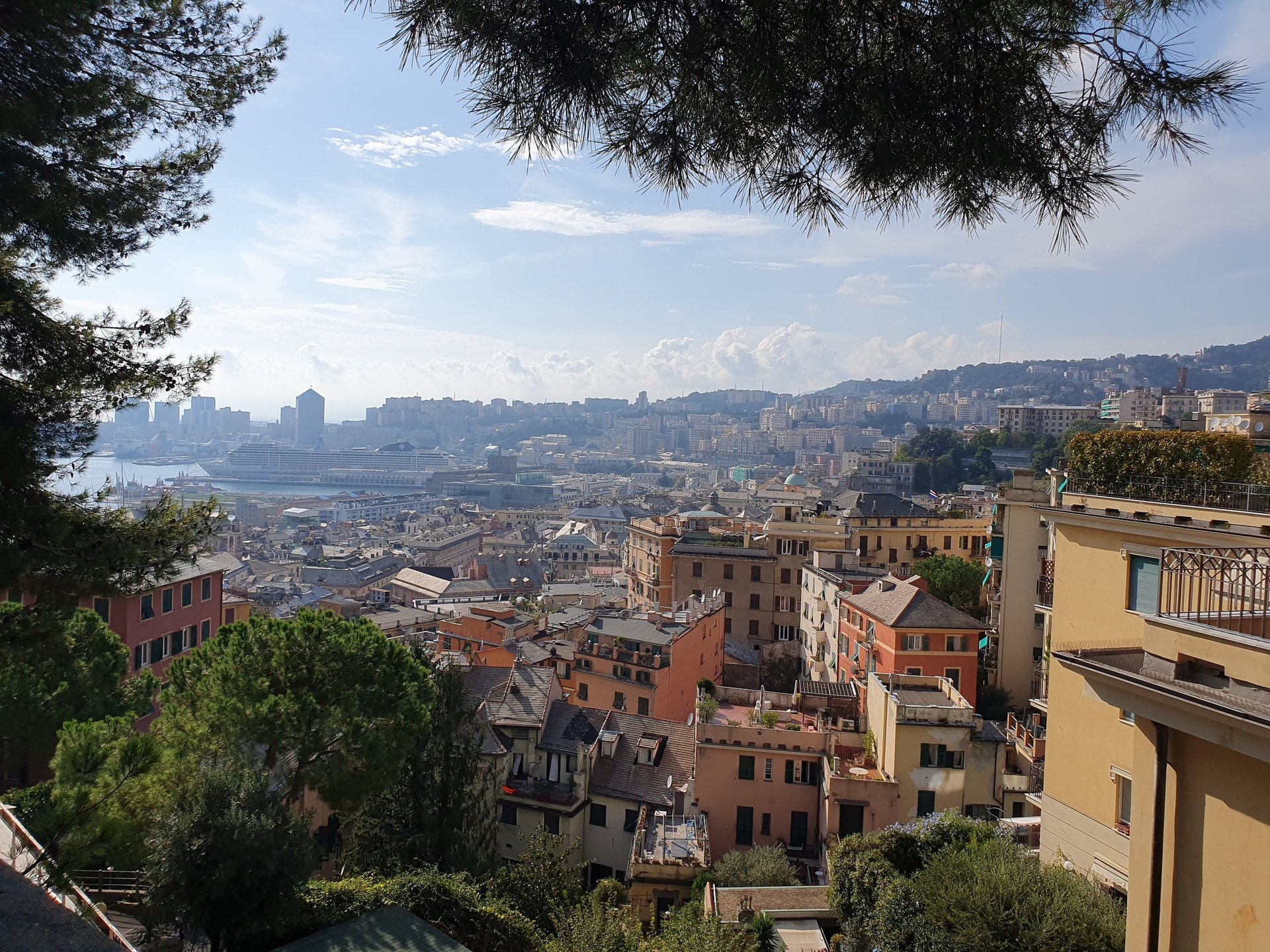
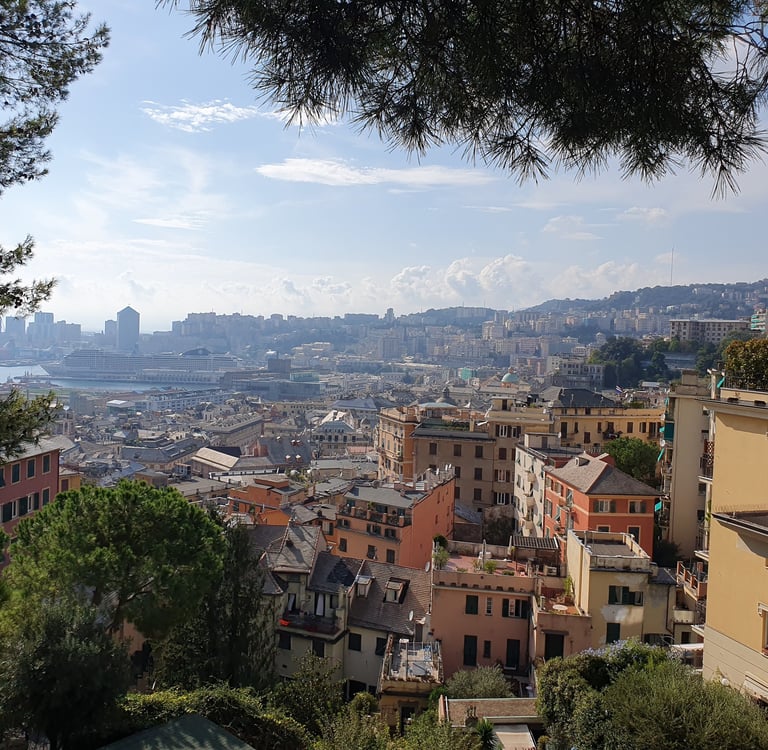
I continued to stroll, weaving my way through the streets to reach the Ascensore di Castelletto Levante, the quaint elevator that whisked me up to the Spianata Castelletto terrace. Built in 1929, this Art Nouveau gem was designed by architect Mario Labò to connect the bustling city below with the serene heights above, a nod to Genoa’s innovative spirit during its industrial boom. Originally powered by a water counterweight system, it’s now been upgraded to electric power, yet still retains its charm with wrought-iron gates and tiled walls. From this vantage point, the city unfurled beneath me, with rooftops stretching towards the port, and cranes standing like sentinels against the shimmering sea. The panoramic view captured the blend of Genoa’s historic character and bustling modernity, which, for me, captures its essence and makes it so rewarding to visit.
After taking the easy option up, I decided to walk back down to the centre via Salita alla Spianata Castelletto, its winding path taking me through the narrow caruggi, their shadowed alleys alive with the hum of daily life. My route led me into Focacceria Fossatello, where I couldn’t resist sampling the focaccia con stracchino e wurst. The warm, cheesy bread topped with savoury sausage was a melt-in-the-mouth delight, crisp on the outside, soft in the middle, a perfect taste of Genoa’s culinary soul.
As the afternoon waned, I returned to Porto Antico, settling at La Golletta bar along Calata Molo Vecchio. With a cold beer in hand and complimentary bowls of crisps and nuts, I gazed out at the superyachts lining the dock. The sleek vessels gleamed under the late afternoon sun, and one in particular caught my eye, the 44m Kauris IV, built by Wally Yachts in 2020 for Marco Tronchetti Provera, the CEO of Pirelli. I could only imagine the adventures it had seen across the Mediterranean. This bar quickly became a favourite, the ambience and view drawing me in. Encouraged by the beauty of the harbour—or maybe the free snacks—I followed the beer with a couple of Aperol Spritz, their vibrant orange hue mirroring the Italian sun as it settled low over the harbour, sealing my affection for this spot.
As evening descended, I strolled back up the narrow lanes of Via di S. Bernardo, passing the quiet Piazza di S. Donato, its serene ambience a gentle contrast to the day’s bustle. Back at my apartment, I opted for a comforting dinner of chilli con carne, a meal I often cook on my travels. The hearty mix of spices, beans, and meat is tasty and easy to prepare, making it a satisfying end to a rich and rewarding day of exploration.
To continue reading, head to: Chapter 4: Rediscovering the Etruscan Coast
Contact
Reach out for questions or collaborations
© 2026. All rights reserved.